The Myth About Competition: How Nonprofits Win More Grants
A nonprofit executive recently told me,
“We almost didn’t apply because we heard there were over 1,000 applicants.”
I asked,
“How many awards did they make?”
She didn’t know.
She had already decided she’d lose before she ever looked at the opportunity.
The biggest myth about grant funding is that the competition determines who gets funded.
It doesn’t.
Alignment does.
Preparation does.
Relationships do.
Clarity does.
Demonstrated outcomes do.
Competition simply determines who else submitted an application.
And, if you’ve ever pursued grant funding as part of your fundraising strategy, then you are no stranger to competition. After all, we’ve all heard about how competitive grant funding is.
Your first thoughts probably sound something like this:
But, there’s a lot of competition for us to win…
But, we’re only a small organization…
But, I don’t have enough time…
But, they only fund organization they know…
Lots of “Yeah, buts”
The truth about competition is that competition surrounds us every day, in every choice we have, and every decision we make.
So, for those that haven’t given up, the question I often hear is: How do we compete?
That’s the wrong question!
The reason it’s the wrong question is that it comes from a place of limiting belief.
Competition isn’t the problem.
Competition is simply the environment
Belief determines how you respond to it.
And your beliefs drive your thoughts and ultimately your behaviors.
Thoughts ➡️ Feelings ➡️ Actions ➡️ Results
So, how does this relate to competition?
Competition lives in our heads, and it’s amplified by the lens in which we view it.
When you view it from a place of disempowerment, then all the “Yeah, but” leap forward to empower negativity.
Those negative thoughts create negative feelings and emotions.
So, how does that affect your actions?
Do you go all in and do your best work OR do you limit your behavior and action taking and hold back?
Let me ask, have you ever heard these excuses or justifications?
Well, we wouldn’t have won it anyway.
Let’s submit for that grant next year, when we’re more ready.
I just don’t know if this one’s right for us right now.
Then, you’re thinking from a place of disempowerment.
And in grant funding it often shows up looking like the difference between desperation versus inspiration.
And if you think about it, we can all tell when someone is speaking from a place of desperation and lack of belief.
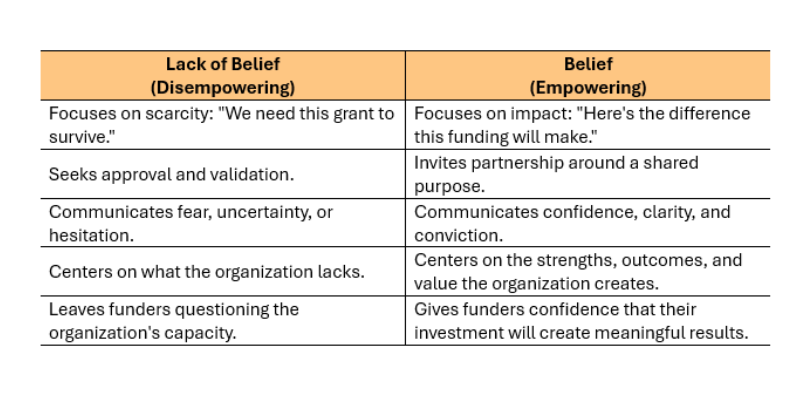
Your words reveal your beliefs.
Your beliefs shape your confidence.
And confidence is what inspires others to believe in your mission.
Funders aren't just evaluating your proposal; they're also evaluating your confidence in your ability to deliver the impact you're promising.
Organizations don’t become competitive because they’re bigger.
They become competitive because they know how to:
Align with a funder’s priorities
Demonstrate organizational readiness
Build relationships before applying
Communicate measurable outcomes
The answer is…
Face competition from a place of belief.
Do this by considering AND + HOW
It’s a simple mindset shift to reframe.
Remember our previous “Yeah, buts”?
Let’s reframe them:
There’s a lot of competition AND we will still apply. HOW can we structure our proposal to stand out?
We’re only a small organization AND we’re surrounded by people who care. HOW can we best leverage our people to pursue this funding opportunity?
I don’t have enough time AND I’m still going to apply. HOW can I find the time I need?
They only fund organizations they know AND they don’t know us. HOW can we introduce ourselves to them to be known?
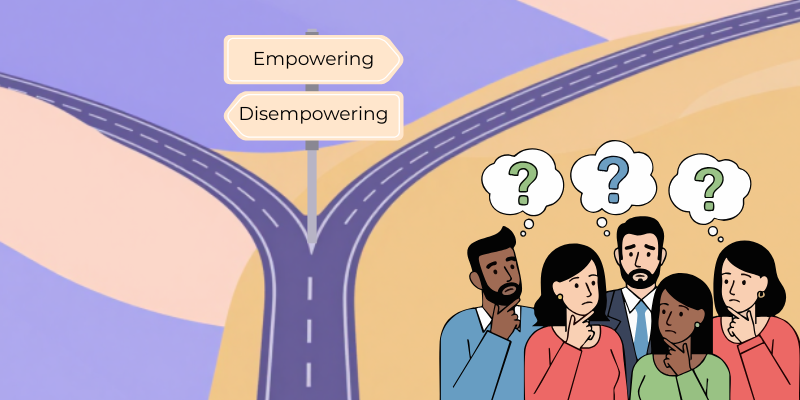
Now you have a decision to make.
Every successful grant starts long before the application is written.
It starts with what you believe is possible.
When you replace "Yeah, but..." with "And...How?" you stop looking for reasons you can't compete and start looking for ways you can.
That's where competitive organizations separate themselves, not because they face less competition, but because... they refuse to let competition determine their effort.