Why Most Grant Applications Fail

Most nonprofits don't lose grant because their work isn't valuable. They lose because they can't clearly demonstrate why their work matters and how it creates measurable impact. Funders aren't just funding programs anymore. You need to think deeper. They're funding outcomes, clarity, and confidence.
Every year, nonprofits pour hundreds of hours into grant applications… only to get a generic rejection email.
No feedback.
No clarity.
No funding.
And if you're like most teams, you've probably assumed the problem is:
“There was too much competition”
“We need a better writer”
But after working with dozens of organizations, we see the same pattern over and over.
Most grant applications don’t fail because of writing, they fail because of positioning.
Are you well positioned or do you have a "Grant Readiness Gap"?
Most organizations are applying before they're ready. Their programs aren't fully defined, they haven't established metrics, or their outcomes aren't tied in with their funding narrative.
Quick Check: Before you read further, find out if your organization is funder-ready.
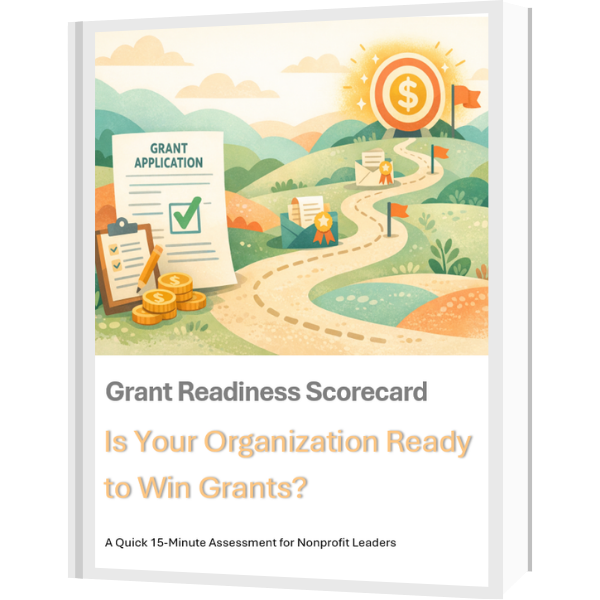
[Download the Grant Readiness Scorecard - A 15-minute quick assessment]
3 Real Reasons Grant Applications Fail
Your Proposal Lacks Clarity of the Outcomes
Most proposals explain:
• The problem
• The urgency
• The mission
But funders are asking and want to know more.
For example: “What measurable change will happen if we fund this?”
RESULT: If your response is unclear and a funder can't quickly see the impact, then they won't fund you. Your application will likely get passed over and tossed out.
Your Proposal Sound Like Everyone Else
Many proposals use the same language filled with jargon and vagueness:
• “We serve underserved communities…”
• “We are committed to impact…”
RESULT: Funders review dozens and sometimes hundreds of applications. If yours blends in with the pack, it will lose and they may not even finish reading it.
3. You Don't Show Implementation Confidence
Even strong ideas fail when funders can’t see:
• A clear plan
• Defined milestones
• Realistic execution
Funders don’t just fund ideas. They fund confidence in delivery.
RESULT: Funders will question your ability to deliver on your program ideas and without confidence that you can deliver results, you'll be looking at rejection.
What Funders Actually Look For
Let's break this down into a simple framework.
Clarity of Outcomes
• What will change?
• Who will benefit?
• How will success be measured?
You must clarify every aspect of the problem you are solving with your funding request. If you can’t quantify it, how can they fund it?
2. Strategic Alignment
• Does your work align with their priorities?
• Can they clearly justify funding you?
Alignment with the funder beats passion every time. Does your proposal actual lean into "why you are you the best fit" for them and their mission?
3. Credibility & Capacity
• Have you done this before?
• Do you have the systems to execute?
Funders are betting on your ability to deliver what you say you can. They want to feel confident that you have to people, resources, and experience to get it done.
4. Implementation Plan
• What happens first, next, and after?
• What are the milestones?
Funders want to understand how their funding will be invested to create the impact and outcomes you've shared. Vague plans kill strong proposals.
5. Measurable Impact
• What data will you track?
• How will you report outcomes?
Funders want to know what the results of their funding of your organization. They want to clearly understand how you plan to measure success.
What This Looks Like in Practice
Let's look at a simplified example:
Weak Positioning:
“We aim to support youth in our community through mentorship programs.”
Strong Positioning:
“We will increase high school graduation rates by 15% among 200 at-risk students through a 12-month mentorship program, measured by attendance, GPA improvement, and graduation outcomes.”
The narratives describe the same mission. But, the strong positioning statement generates a completely different level of funder confidence. It is clear and compelling.
What To Do Next
If you want to improve your grant success rate, here's some first steps:
Step 1: Audit Your Last Application
Where did you:
• Lack clarity?
• Miss outcomes?
• Over-explain instead of prove?
Step 2: Map Your Outcomes First
Before writing anything:
• Define your success metrics
• Identify measurable impact and how can you plan to track it
Step 3: Build a Simple Execution Plan
Outline:
• Timeline
• Activities
• Milestones
Step 4: Use a Funder Lens
Ask yourself this: “If I were reviewing 50 applications, would this application stand out?”
Conclusion
Most grant applications don’t fail because the work isn’t important.
They fail because the proposal doesn’t make it easy for funders to say yes.
Consider shifting your primary focus:
• Story → Strategy
• Need → Outcomes
• Passion → Proof
You won't just submit better applications. You become fundable!
If you want a faster way to identify gaps before your next submission:
Take our quick, 15-minute assessment.
Get a quick score learn what could be holding your organization back from winning more grants.